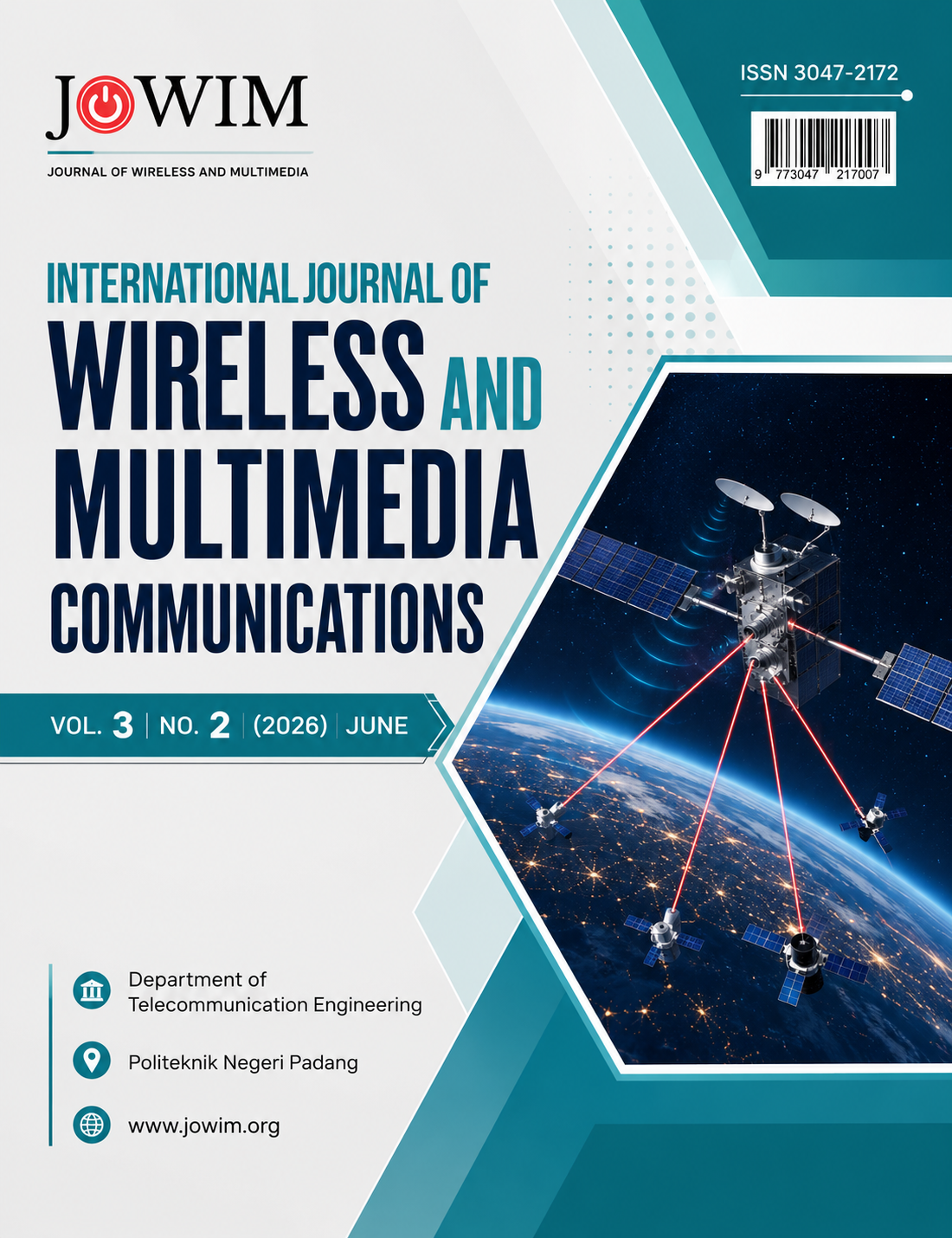
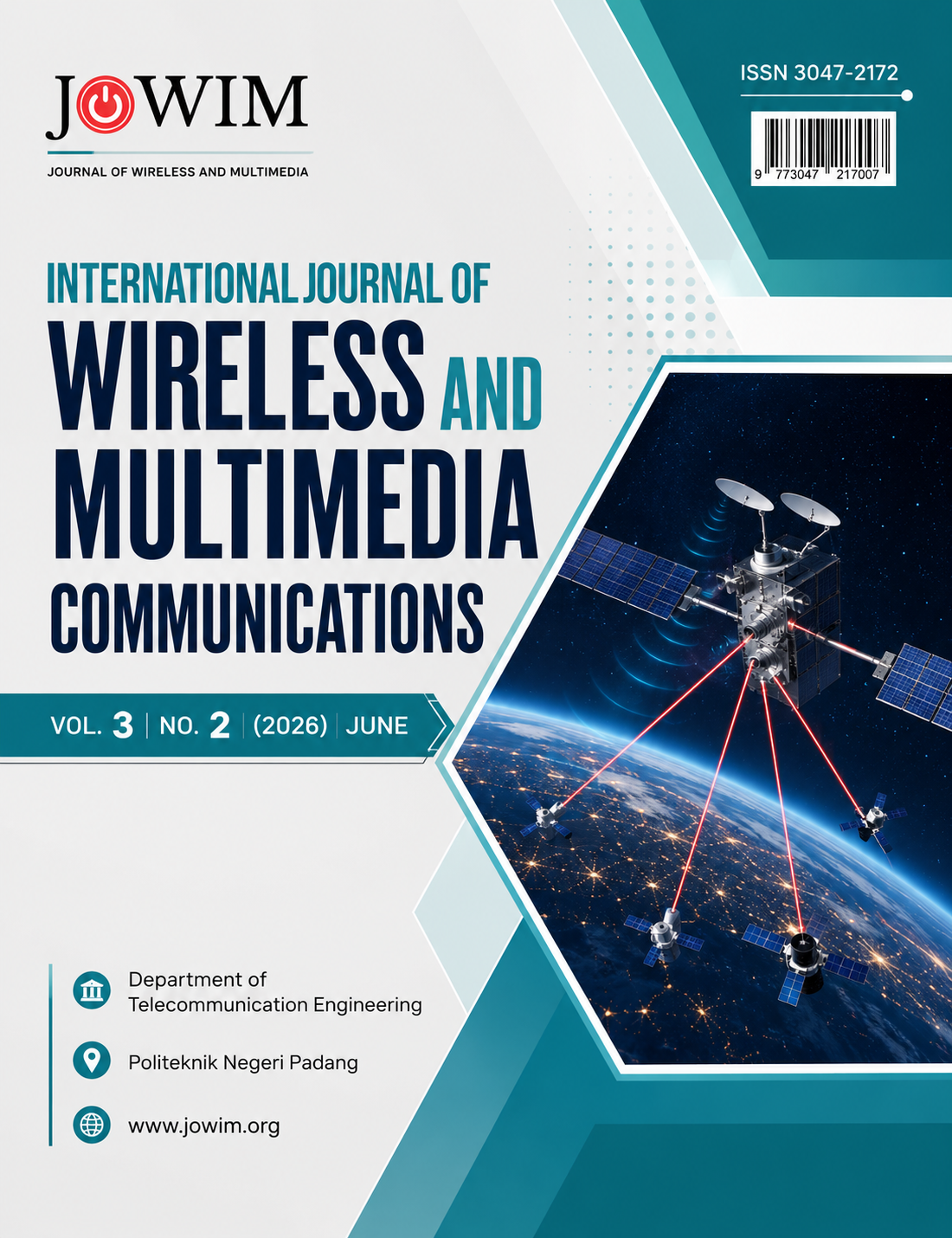
Comparison Download and Upload ofLong Term Evolution Time Division Duplex 2300 Mhz and Fdd 2100 Mhz
DOI:
https://doi.org/10.62671/jowim.v3i2.141Keywords:
SINR, RSRP, FDD, TDDAbstract
Data communication such as downloads and uploads are used by users on different channels, namely downlink and uplink in data transceiver. This study analyzed the download and upload results of Time Division Duplex (TDD) 2300 MHz and Frequency Division Duplex (FDD) 2100 Mhz. The bandwidth used is 20 MHz. This research was conducted in the Cengkeh Nan XX area because of the availability of both TDD and FDD technologies in this area and including densely populated areas, so good service performance is needed. The average FDD Reference Signal Received Power (RSRP) value of downloaded and uploaded is in the very good category (-95 ≤ x < -80 dBm) of -91.4 dBm and -89.4 dBm, while TDD is included in the Good category (-100≤ x < -95 dBm) of -98.2 dBm and -97.6 dBm. The average TDD Signal to Interference Noise Ratio (SINR) downloaded and uploaded is in the very good category (10 ≤ x < 20 dB) of 13.4 dB and 12.1 dB, while FDD is included in the Good category (0≤ x < 10 dB) of 8.9 dB and 7.4 dB. Average download throughput on PDCP (Packet Data Convergence Protocol) and Physical Layer TDD is included in the very good category (500 ≤ x < 100,000 kbps) which is 22,457.3 kbps and 26,842.3 kbps, while FDD is 18,687.7 kbps and 21,790.6 kbps. Average Upload Throughput on PDCP and Physical Layer FDD is included in the very good category (2000 ≤ x < 5000 kbps) which is 3733.12 kbps and 4425.9 kbps, while TDD reaches 2832.34 kbps and 3175.4 kbps. TDD and FDD technologies use different frequencies and multiplexing techniques resulting in differences in service performance. Based on the results of the study, it was analyzed that the best parameters in FDD are RSRP and Upload Throughput, while in TDD frequencies are SINR, Download Throughput. Thus, TDD and FDD technologies are used in certain categories and purposes.
Downloads
References
[1] Y. Saragih, R. Satrio Hadikusuma, and A. Elisabet S, “Evaluation of cellular network performance involving the LTE 1800 band and LTE 2100 band using the drive test method,” J. INFOTEL, vol. 14, no. 4, pp. 294–300, Nov. 2022, doi: 10.20895/infotel.v14i4.833.
[2] D. Chandra, S. Yusnita, D. B. Sitepu, A. Mursydan, and D. Meidelfi, “LTE Network Area Coverage on FDD and TDD Technology,” Int. J. Adv. Sci. Comput. Eng., vol. 2, no. 1, pp. 21–33, Apr. 2020, doi: 10.62527/ijasce.2.1.47.
[3] M. Ulema, Fundamentals of Public Safety Networks and Critical Communications Systems. Wiley, 2018. doi: 10.1002/9781119369554.
[4] N. N. Sirhan and M. Martinez-Ramon, “LTE Cellular Networks Packet Scheduling Algorithms in Downlink and Uplink Transmission: A Survey,” Int. J. Wirel. Mob. Networks, vol. 14, no. 2, pp. 1–15, Apr. 2022, doi: 10.5121/ijwmn.2022.14201.
[5] R. Saadia and N. M. Khan, “Single Carrier-Frequency Division Multiple Access Radar: Waveform Design and Analysis,” IEEE Access, vol. 8, pp. 35742–35751, 2020, doi: 10.1109/ACCESS.2020.2974935.
[6] N. . Seraji and T. & Ahmed, “Performance Analysis of the Physical Layer of Long-Term Evolution (LTE),” Aust. J. Eng. Innov. Technol., pp. 72–93, Apr. 2023, doi: 10.34104/ajeit.023.072093.
[7] R. Manda, A. Kumar, and R. Gowri, “Optimal Filter Length Selection for Universal Filtered Multicarrier Systems,” Int. J. Eng., vol. 36, no. 7, pp. 1322–1330, 2023, doi: 10.5829/IJE.2023.36.07A.13.
[8] F. Kusuma and H. Putri, “Increasing LTE-Advanced Network Capacity Using The Inter-band Carrier Aggregation (Downlink Side) Method,” J. INFOTEL, vol. 12, no. 2, pp. 52–59, May 2020, doi: 10.20895/infotel.v12i2.474.
[9] D. Chandra, F. A. Rahmat, S. Aulia, F. -, and A. F. Kasmar, “Effect of Modulation on Throughput of 4G LTE Network Frequency 1800 MHz,” Int. J. Adv. Sci. Comput. Eng., vol. 5, no. 1, pp. 44–53, Apr. 2023, doi: 10.62527/ijasce.5.1.121.
Downloads
Published
Issue
Section
License
Copyright (c) 2026 Aisyah Vianda Putri, Alifia Amanda (Author)

This work is licensed under a Creative Commons Attribution-NonCommercial-ShareAlike 4.0 International License.